

The vertical micro-drama "European Dreamers" is getting on track!
- Now Age Storytelling team

- Feb 10
- 2 min read
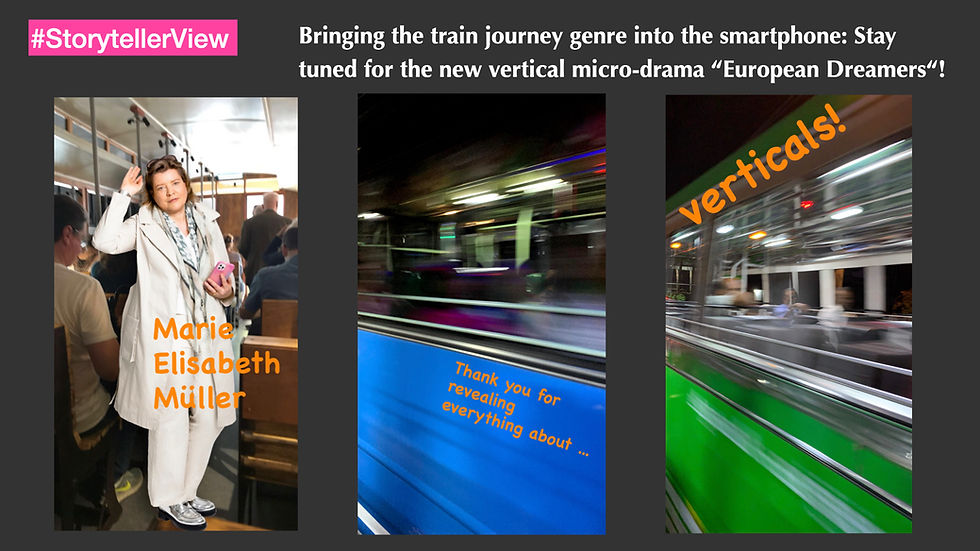
Great how quickly Kerstin Höckel is getting the vertical micro-drama “European Dreamers” on track.
Elisabeth is very excited and happy to be a small part of it. Thanks for the feature! 👇🏻
Elisabeth—Liz to many—is a vertical storyteller from the very beginning. As a creative director, author, and trainer, she discovered the creative superpower of smartphones in the early 2000s while living and working in Nairobi for four years.
These small media houses in people’s pockets enabled many to give themselves and their communities a voice—affordably, independently, and without gatekeepers. They opened paths to new business models, sustained connections across vast distances, and, above all, made space for new kinds of stories.
Elisabeth earned her PhD at the University of Konstanz, researching Peter Greenaway’s non-linear film language, and spent fifteen years working as an editor and director for SWR. Since then, she has devoted herself to exploring the distinctive narrative forms and production methods of vertical storytelling.
“What fascinates me is the intimacy of this audiovisual grammar and the freedom we gain when we tell stories with the smartphone for a smartphone audience—or invite the audience in as co-creators. You step into a real-time laboratory with no universal rulebook.”
Together with colleagues at media organizations and universities in Germany, India, Denmark, and the United States, she continues to develop new formats and genres such as vertical reportage, micro-stories, and the Global Pop-up Newsroom.
Since childhood, Elisabeth has loved traveling by train. “On a train, you feel time, distance, and yourself. I can let go, drift into thought, and enter, for a while, a world of its own—made of people and sounds. In India, I often travelled long distances by night train, to the quiet astonishment of fellow passengers, as Europeans are rarely seen there. Outside, it is pitch dark. I liked the idea of being a tiny part of the universe, moving across this vast continent, and for a few hours, no one knowing who I was or where I was.”
It is no coincidence that the histories of cinema and the railway feel like twins in the evolution of media. This is precisely why the micro-drama project European Dreamers fascinates her: it brings the genre of the train journey into the smartphone.


Comments